The successor to Illuminate · From N2N Services & LightLeapAI
As Illuminate Sets, Helios Rises.
Fifteen years ago we built Illuminate so higher education could finally share its data on its own terms. Today we're retiring that chapter — and replacing it with something we've been quietly building for two years. Helios is the integration platform reborn for the agent era: API-first, agent-native, audit-by-default, and ready for the composable enterprise.
Higher education has been wrestling with the same data-portability problem for a generation. Helios is the answer we've been quietly building — and our marketing team made a quick film to explain why it matters.
Why every institution's data should flow, not gatekeep.
How LightLeapAI is leading the leap.
What Helios changes about the integration playbook.
Illuminate proved that integration belonged to everyone. Helios is what comes next.
Illuminate (2010 — 2026)
A turnkey API platform for higher ed.
Illuminate Photon, Wave, and Spectrum let business users publish APIs over Banner, Colleague, PeopleSoft, and the rest — without programmers, without expensive middleware, in minutes instead of months. It worked. It still works.
500+ APIs shipped across 400+ institutions
3M transactions/day at peak
15 years of compliance-grade uptime
Cumulative across N2N's Illuminate installed base, 2010–2026.
Helios (2026 — )
An agent platform that ships APIs and ships agents.
Helios keeps every promise Illuminate made — fast, secure, turnkey API publishing — and then takes the next step. Every API becomes a step in an Arazzo-native agent pipeline. Every pipeline is governed, audited, and explainable. Every customer ships the integrations and the agents that move on top of them.
Arazzo-native deterministic pipelines
Claude on Bedrock for every reasoning step
FERPA, GLBA, SOC 2 aligned from line one
The platform
Seven pillars. One platform. Zero compromise.
Helios isn't a chatbot bolted to a database. It's a complete integration and agent platform — built on the same connect-anything-to-anything mission N2N has run on since 2010, now with the AI layer customers needed all along.
01
Connect anything to anything
Our core mission since 2010 — fifteen years before Helios shipped. Banner, Workday, PeopleSoft, Oracle, Anthology, Ellucian SaaS, custom databases, Excel uploads, REST, GraphQL, SOAP, and the legacy XML that still runs your transcript office. Every connector N2N has ever built — inherited by Helios as the substrate every agent stands on. The AI is what we add on top; integration is the ground we never stopped owning.
02
Agent Dashboard
Status, runs, errors, and latency for every agent in your tenant — card or list view, sortable, filterable, exportable.
03
Agent Studio
Four-step wizard — Identity, Pipeline, Triggers, Governance — built on the open Arazzo orchestration spec. Sandbox before you ship.
04
API Builder
Build, integrate, and monitor APIs from one workspace. Start with hundreds of catalogued higher-ed APIs as your library, author new ones OpenAPI-first, integrate them into agents and pipelines in one click, and watch the runtime telemetry the moment they ship.
05
API Logs
Traffic, errors, latency, and trace-level detail per request. Group by API, filter by status, drill into a single failure.
06
Admin Console
Users, roles, audit log, security policies, account filters, and institutional proxying — everything an enterprise admin expects.
07
Guest Experience
Start building without an account. Helios meets first-time users with a Perplexity-style prompt, scoped tools, and inline signup — zero friction, full audit trail.
Take Helios for a spin
Six minutes from blank prompt to deployed agent.
Real screens from the live Helios platform. Scroll through the tour — or open the guest experience in a new tab and follow along.
01 / 06·Guest experience
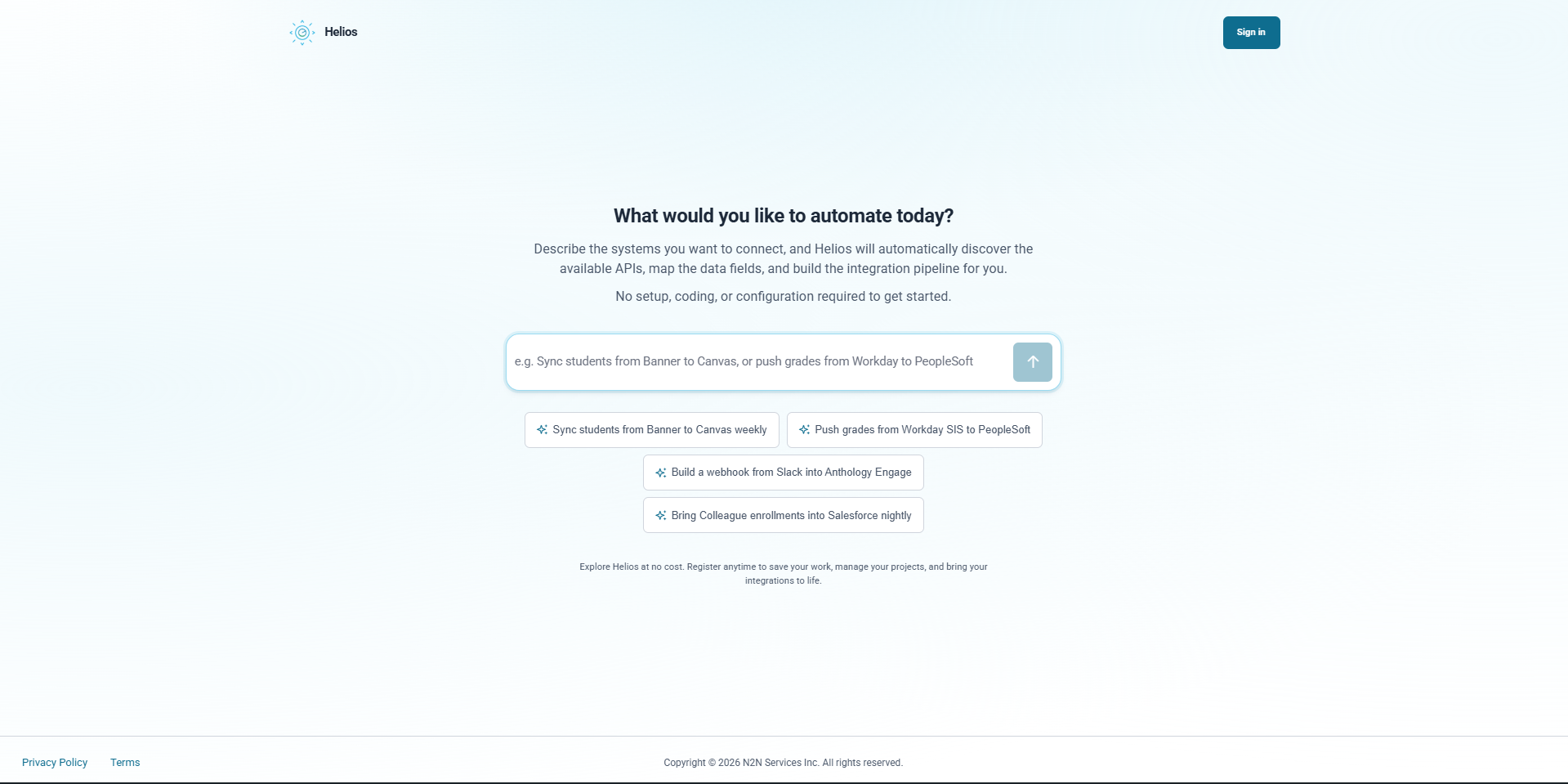
Start typing. Helios takes it from there.
Land on helios.lightleap.ai, describe the systems you want to connect, and watch Helios automatically discover available APIs, map the data fields, and start drafting the integration pipeline — live. No setup, no signup, no credit card. Four suggested prompts get you to a working blueprint in under a minute.
helios.lightleap.ai
"What would you like to automate today?" — the only question on the page.
02 / 06·Integration Builder
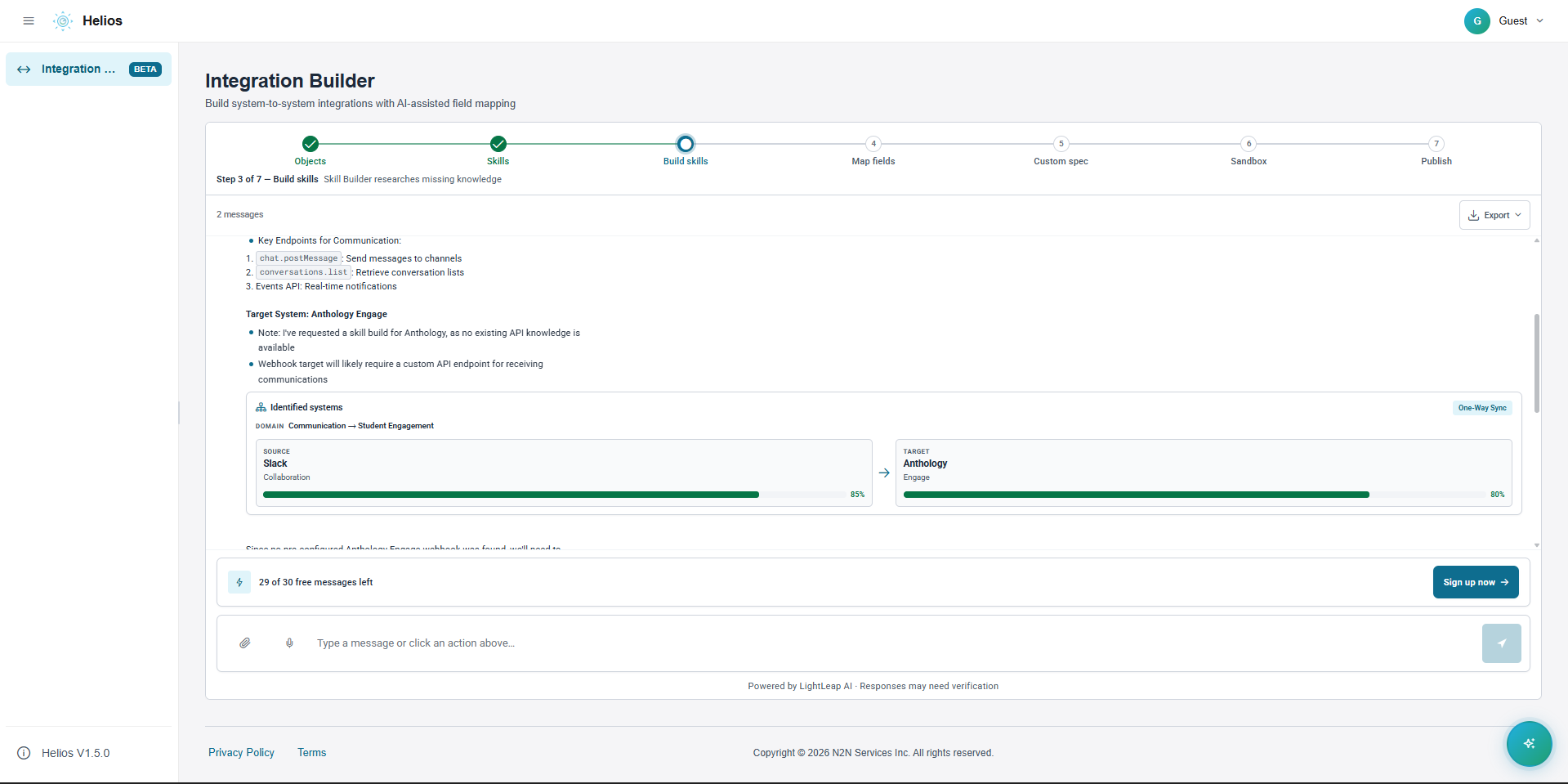
A conversation that ships an agent.
Seven guided steps: intent → research → systems → build skills → map fields → custom spec → publish. Helios identifies your source and target systems with confidence scoring, drafts field mappings from real vendor schemas, and walks you through every decision. Edit any step. Reject any suggestion. Sign off when you're ready.
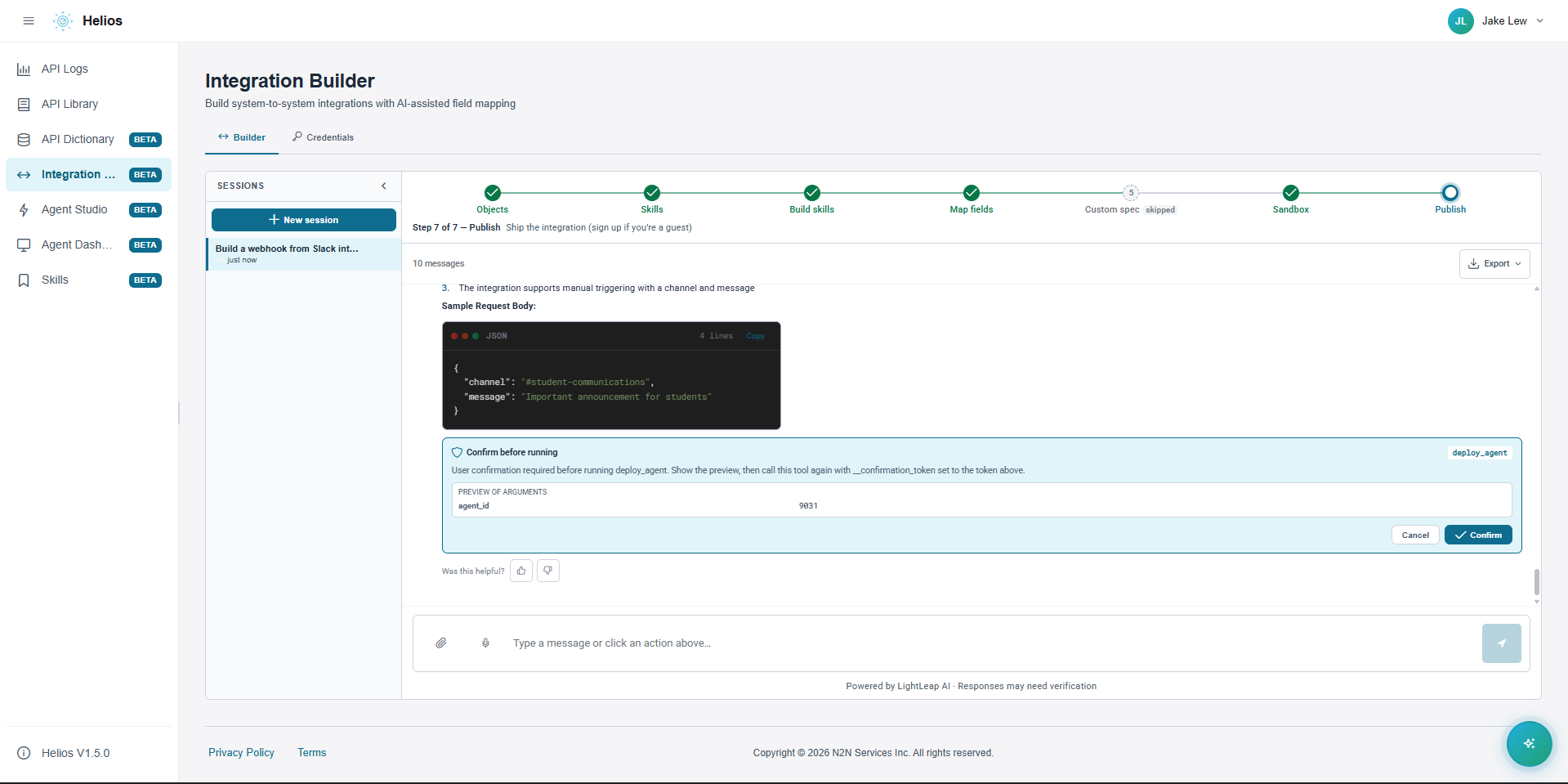
Every write action — build agent, deploy agent, send message — pops an inline confirmation card with the exact JSON the tool will execute and a one-time token. Read-only queries don't need a token. Mutating actions always do. Auditable by construction, governed by default.
helios.lightleap.ai/helios/#/integration-builder
deploy_agent waits for your explicit Confirm before the runtime touches anything.
04 / 06·Agent Studio
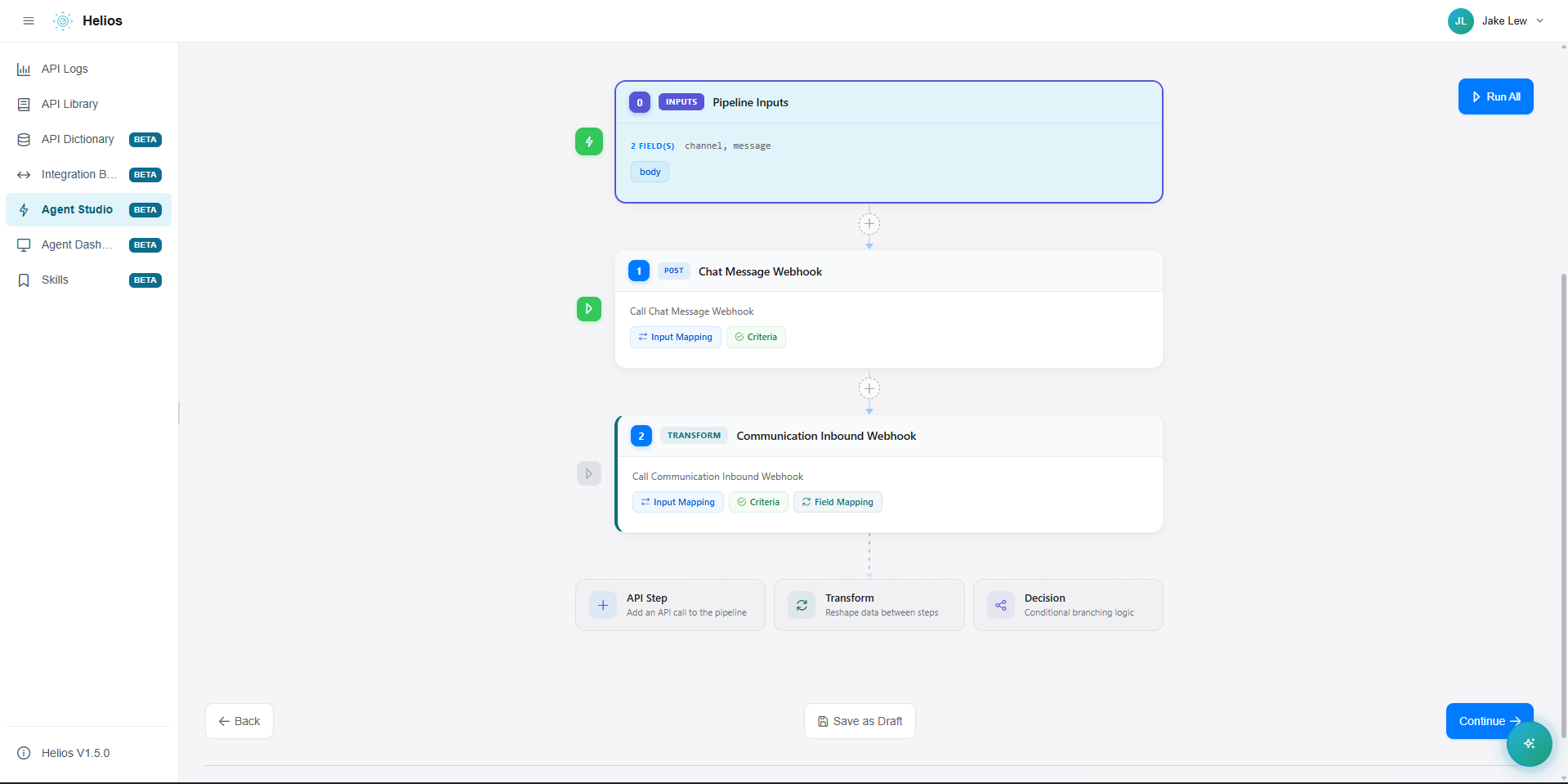
Build precise agents without the chat.
When you want to bypass the conversational builder, Agent Studio is four direct steps: Identity → Pipeline → Triggers → Governance. Drag API steps, transforms, and decisions onto an Arazzo-native canvas. Choose how the agent runs — schedule, webhook, chat-invoked, or manual. Set ICCP compliance (FERPA, HIPAA, PCI-DSS, Institutional Confidential) at the agent level, not the deployment level.
helios.lightleap.ai/helios/#/agent-studio
Pipeline Inputs → Webhook → Transform. Drag, configure, and review every step.
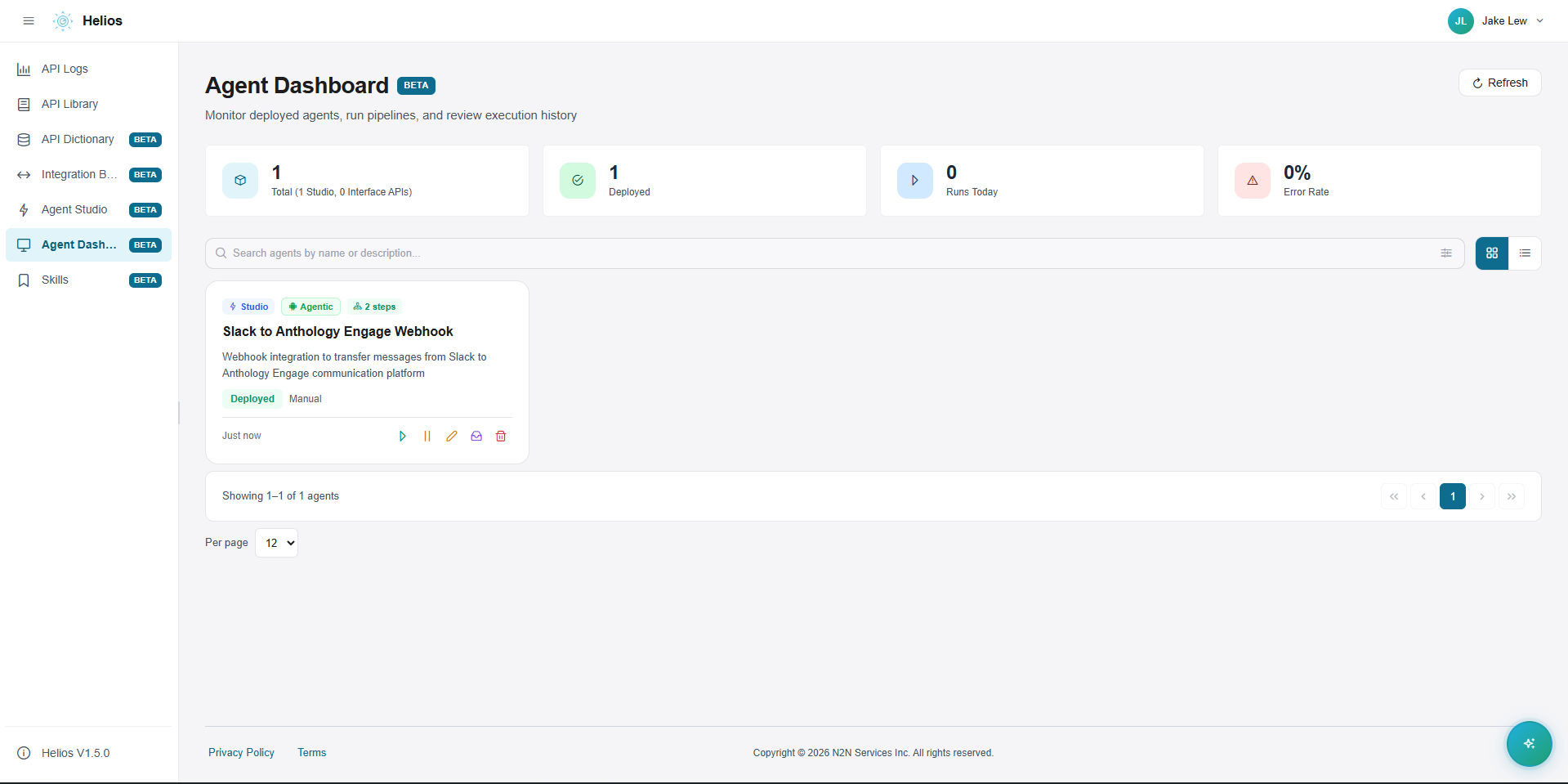
05 / 06·Agent Dashboard
A control room for every agent you ship.
Live counters for total agents, deployed, runs today, and error rate. Card or table view of every agent with method, source, version, run health, and last execution time. Move from "I think it ran" to "I know it ran, in 699 ms, with these inputs." One canvas, every agent, every tenant.
helios.lightleap.ai/helios/#/agent-dashboard
One deployed. Zero errors. The way every integration platform should look.
06 / 06·API Dictionary & Skills
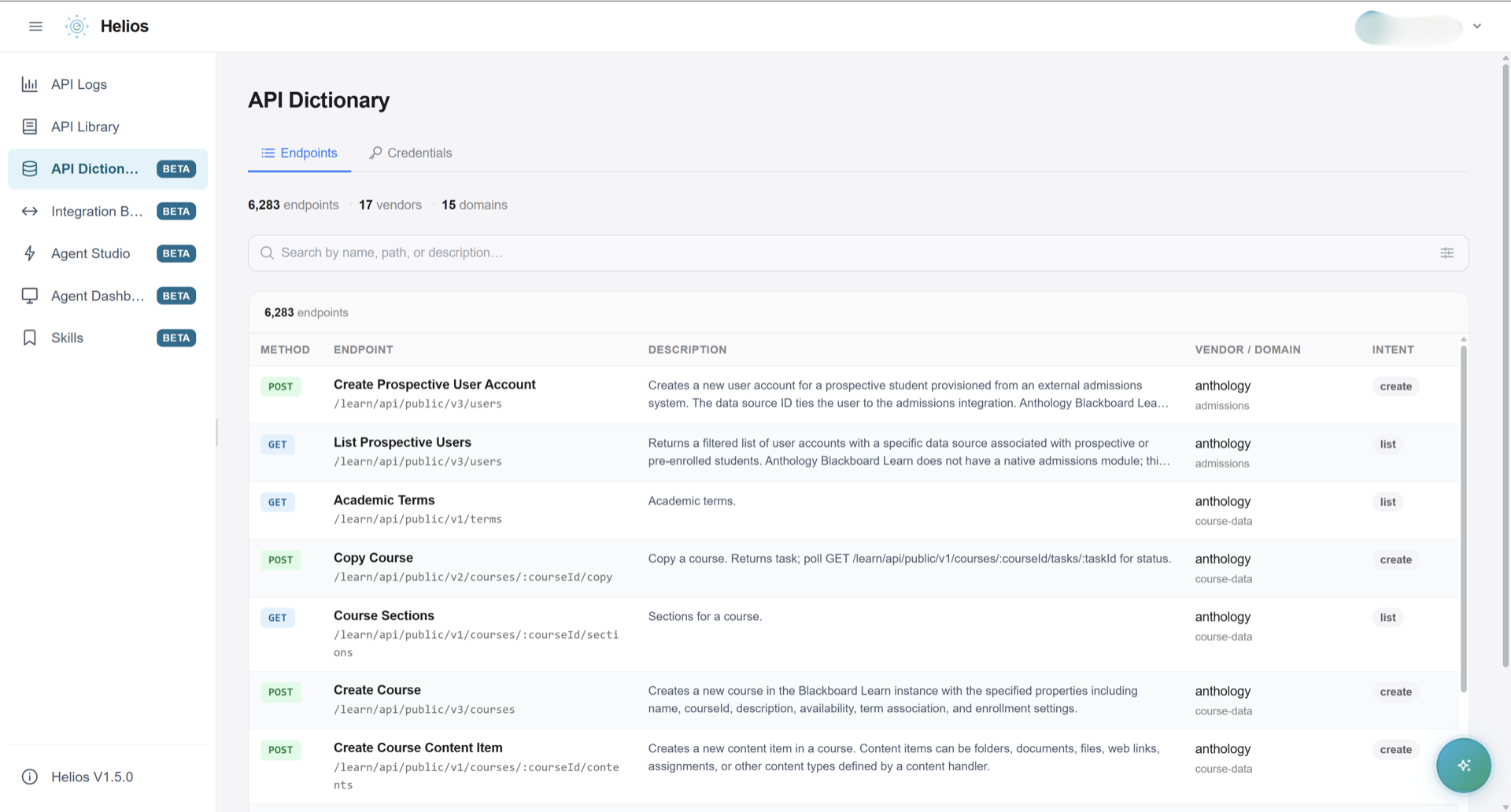
Six thousand endpoints. Trained knowledge. Auditable.
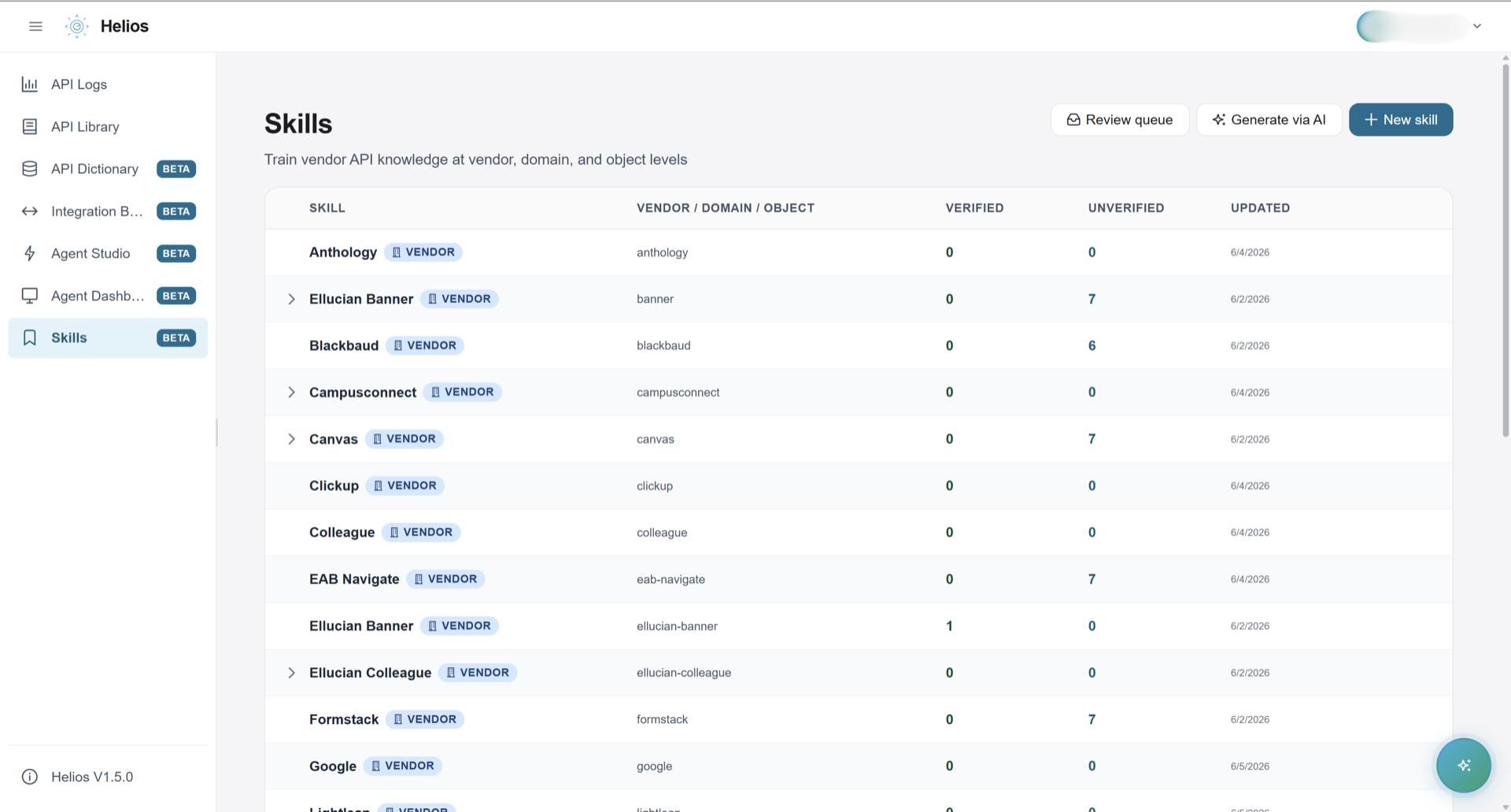
6,283 vetted endpoints across 17 vendors (Anthology, Banner, Workday, Canvas, Colleague, EAB Navigate, Ellucian Banner, Ellucian Colleague, Formstack, Google, and more) and 15 domains. Every endpoint described in plain English so the agent can find it. Skills are versioned, audit-logged, and trace every agent action back to named, verifiable knowledge — generated by AI, reviewed in a queue, trusted at runtime.
helios.lightleap.ai/helios/#/api-dictionary
6,283 endpoints, indexed by vendor and domain, queryable by every agent.
helios.lightleap.ai/helios/#/skills
Skills are the trained vendor knowledge agents reason against — every action traceable to a named, reviewable skill.
Now your turn
Stop watching the tour. Start building.
Skip the gate, type the integration you want to build, and watch Helios research, propose, and draft it for you — live, in your browser.
We will not strand a single Illuminate customer. Every workspace, every API, every scheduled job has a defined successor in Helios — and a defined timeline to get there.
01
Audit
We inventoried every Illuminate workspace, API, scheduled job, and integration partner. Nothing was sunsetted without a successor.
02
Mirror
Helios was built API-first to match Illuminate's surface area — Photon, Wave, and Spectrum workloads all have a direct Helios equivalent.
03
Cutover
Customers move on their timeline. Existing Illuminate tenants stay supported through their contract term while Helios becomes the default for every new institution.
Our promise: Existing Illuminate tenants remain fully supported through the term of their current contract. Cutover happens on your schedule — not ours.
We don't do annual "releases" with marketing windows. Helios ships every week, and every change is published — engineering notes, release notes, the works.
June 4, 2026Platform
Guest experience + Bedrock reliability
First-time visitors can now land on helios.lightleap.ai and start a real Integration Builder conversation with no signup. Bedrock client timeouts retuned for 64K-token Sonnet generations.
June 4, 2026Brand
Helios logo refresh
New brand mark — a stylized sun wrapping a compass dial — rolled across in-app UI, favicons, and the new helios.lightleap.ai landing.
June 4, 2026Studio
Integration Builder — 7-step workflow
IB now walks builders through intent → research → systems → blueprint → mapping → pipeline → review with knowledge-verification trust scoring at every step.
June 2, 2026Agents
Skills KB framework
Skills are now versioned, evaluated, and audit-logged. Every agent action traces back to a named skill — no more "the LLM just decided."
May 20, 2026Governance
IB Phase 4 — intent + cost ledger
Per-tenant cost ledger across Bedrock, web research, and tool execution. Caps, alerts, and a chargeback-ready export.
May 17, 2026Platform
Fabric M5 — audit writer + persistence substrate
Compile-time audit writers and a persistence substrate that survives process restarts and session migration. Built for the regulated enterprise.
Skip the gate
Build your first agent in 60 seconds. No signup. No sales call. Just Helios.
Land on helios.lightleap.ai, type the integration you want to build, and watch Helios research, propose systems, and start drafting a blueprint in real time. When you're ready, sign up inline — your conversation comes with you.